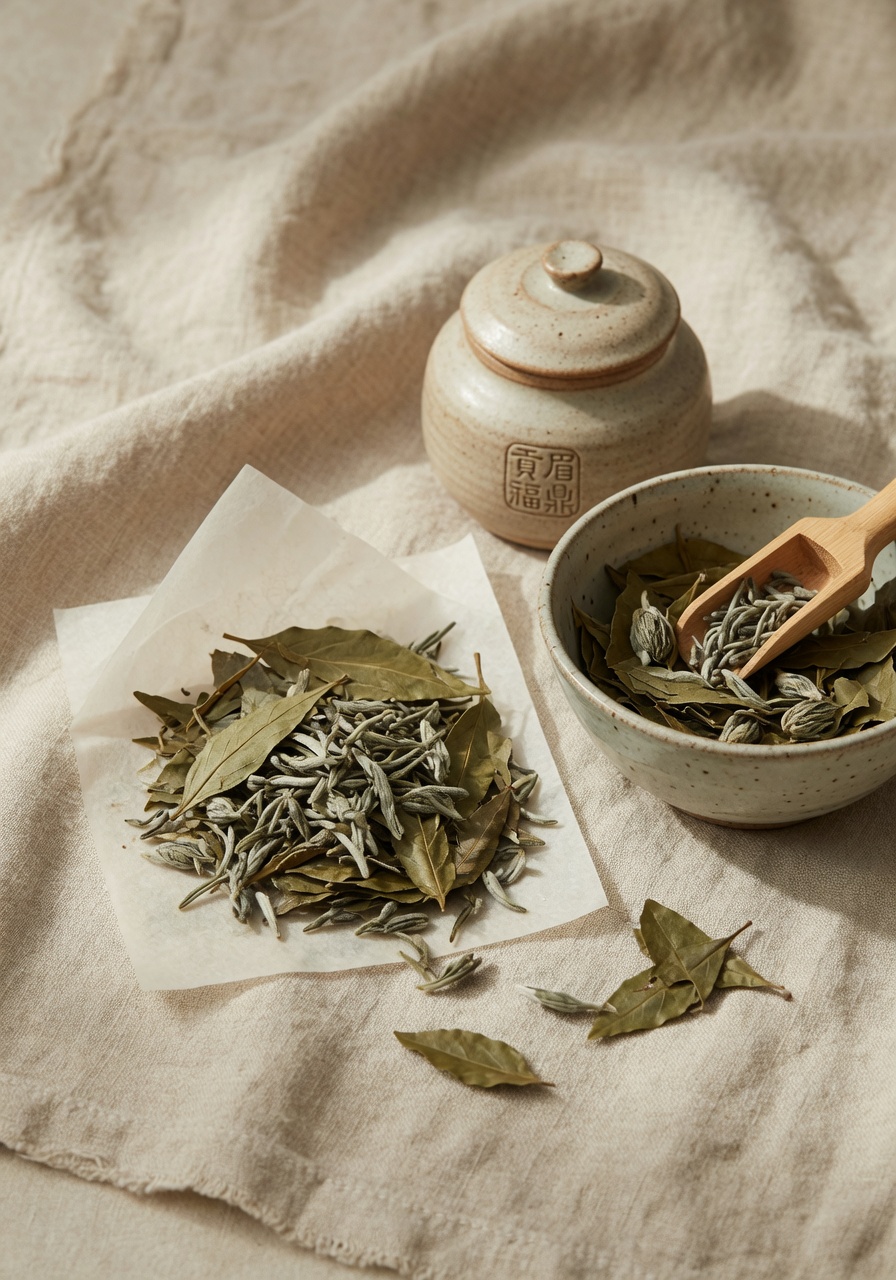
Withered slow on bamboo trays above Diǎntóu
Chen Hui Yi sourced this lot from a small grower above Diǎntóu town in Fúdǐng, on the inland slopes where morning fog holds until late and the afternoon sun arrives dry. The bushes are cài chá — seed-grown, mixed-age plants that the family has refused to replace with grafted clones. The leaf was picked in the second week of April, after the bái háo yín zhēn harvest had closed, when the bud-and-two-leaf flush carries more body and less down.
Hui Yi visits Fuding twice each spring. Her notes on this lot describe a fifty-two-hour wither across slatted bamboo trays, rotated by hand four times a day, then a brief low-heat finish to lock the moisture below seven percent. No rolling, no shaping — the leaf keeps its open, slightly ragged form, stems intact. This is what separates a true gòng méi from the more common shòu méi grade: the picking standard is finer, and the wither is longer and more careful.
She chose this lot for the sample program because it shows what unhurried sun-withering does to ordinary cultivar leaf. There is no rare-tree story here, no high-mountain mystique — only craft, weather, and time. The 2026 spring was unusually dry in coastal Fujian, which concentrated the orchard-fruit character earlier than usual. Hui Yi suggests drinking half this packet fresh and resting the other half a year to compare.