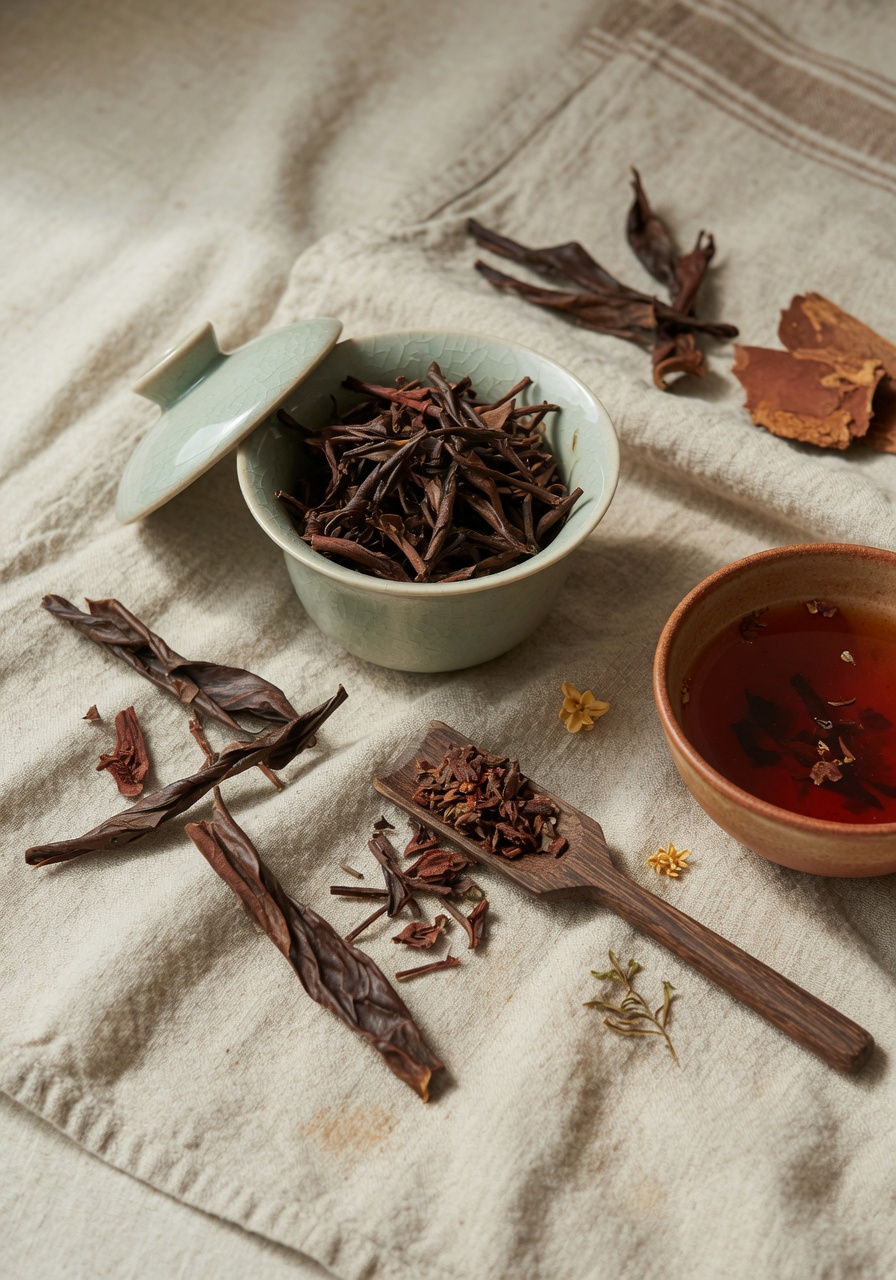
This rou gui comes through a long-standing contact in the Wuyi village of Tianxin, inside the protected zhengyan core zone. The bushes grow at around 480 metres on weathered volcanic scree, the soil that gives yancha its mineral signature — what local growers call yán yùn (rock rhyme). Picking happened in the first week of May 2026, slightly later than the headline harvest, when the leaves had thickened enough to hold a second firing without going hollow. The maker rested the tea four weeks between the first and second roast, a slower schedule than commercial lots but one asked for specifically. The lot was chosen to keep evolving on the shelf for two or three years, not to peak the month it ships. The 2026 lot is rougher at the edges than 2025: more spice, less obvious sweetness, but a steadier mineral spine. Drink half the sample now and rest the remainder until autumn, then compare. It is the same patience a beeng of sheng asks for — only the timescale is shorter.
The leaf, brewed
Cassia bark, warm stone, a long sweet tail
dry leaf
Dark, tightly twisted strips with a matte sheen — dry aroma of cinnamon bark and toasted grain.
wet leaf
Opens to copper-red edges on olive leaves — smell shifts to baked plum, hot rock, faint vanilla.
liquor
Deep amber with an orange ring at the cup edge — bright clarity, no haze even at peak strength.
aroma
Cassia, scorched sugar, river stone after rain — the roast sits behind the spice rather than over it.
taste
Spicy entry, narrow and focused, then a mineral mid-palate that broadens into stewed peach and brown butter. Light astringency holds the shape together.
finish
Long cooling huígān — yán yùn lingers on the back palate, returning sweet for two or three minutes.
Brewing
A method, not a recipe.
Method
gongfu
Ratio
5g / 100ml
Water temp
100°C
First infusion
8s after a quick 3s rinse
Subsequent
8–10 steeps, adding 3–5s per round from infusion 4 onward
Use a thin-walled gaiwan or a small zhuni pot. Pour high to wake the roast — the cassia note shows clearest in steeps two through five.
If this becomes your daily leaf
This 5g sample is a taste, not a supply. The full tin lives at shop.thetea.app.