tea.gratis · sampling channel Encyclopedia · School · Atlas · Pu-erh · Equipment EN · RU · · · FR · ES · AR
tea.gratis Cart (0)
Bi Luo Chun · Dongting 2026
dry
wet
liquor
plantation

home · green-tea-samples

Green tea samples — Spring 2026

Bi Luo Chun · Dongting 2026

Bì Luó Chūn

碧螺春

Tiny downy spirals from the Dongting hills — orchard-sweet, soft chestnut, the kind of green that smells like the lake morning it came from.

Free · paid shipping only

Weight
5 g
Harvest
Spring 2026 (pre-Qingming)
Elevation
200 m
Cultivar
Dongting Qunti (local seed-grown population)
Processing
Hand-plucked one-bud-one-leaf, kill-green in dry wok, hand-rolled into spirals, low-heat finish
Sourced by

From the fruit-tree slopes of Dongting Mountain

Bi Luo Chun is one of the few teas in China grown intercropped with fruit trees — loquat, peach, plum, apricot — on the steep slopes of Dongting East and West Mountains, two islands sitting in Lake Tai near Suzhou. The bushes share soil and air with the orchards, and that’s where the tea’s signature stone-fruit aroma comes from. It isn’t perfume added in processing — it’s literally what the leaves grow up breathing.

Chen Hui Yi selected this lot during her pre-Qingming sourcing trip in late March 2026. Her background is in Guangdong whites and sun-withering, so she approaches greens with a withered-tea sensitivity: she looks for leaves that smell sweet before any heat touches them. The grower is a small family operation on Dongting West Mountain working roughly 0.4 hectares of seed-grown qunti bushes, no clonal varietals, average bush age around forty years.

Picking standard is strict — one bud with a single just-opened leaf, harvested before sunrise while the down is still tight to the bud. It takes about 60,000 to 80,000 hand-plucked sets to make 500g of finished tea. Kill-green happens in a dry iron wok at moderate heat, then the leaves are rolled by hand into their spiral shape and finished at low temperature to preserve the silver fuzz.

This 5g sample is meant as an introduction — enough for two careful sessions. If it lands for you, the full tin lives on shop.thetea.app under Chen Hui Yi’s spring greens shelf.

The leaf, brewed

Soft chestnut, white-flower lift, clean lake-water finish

dry leaf

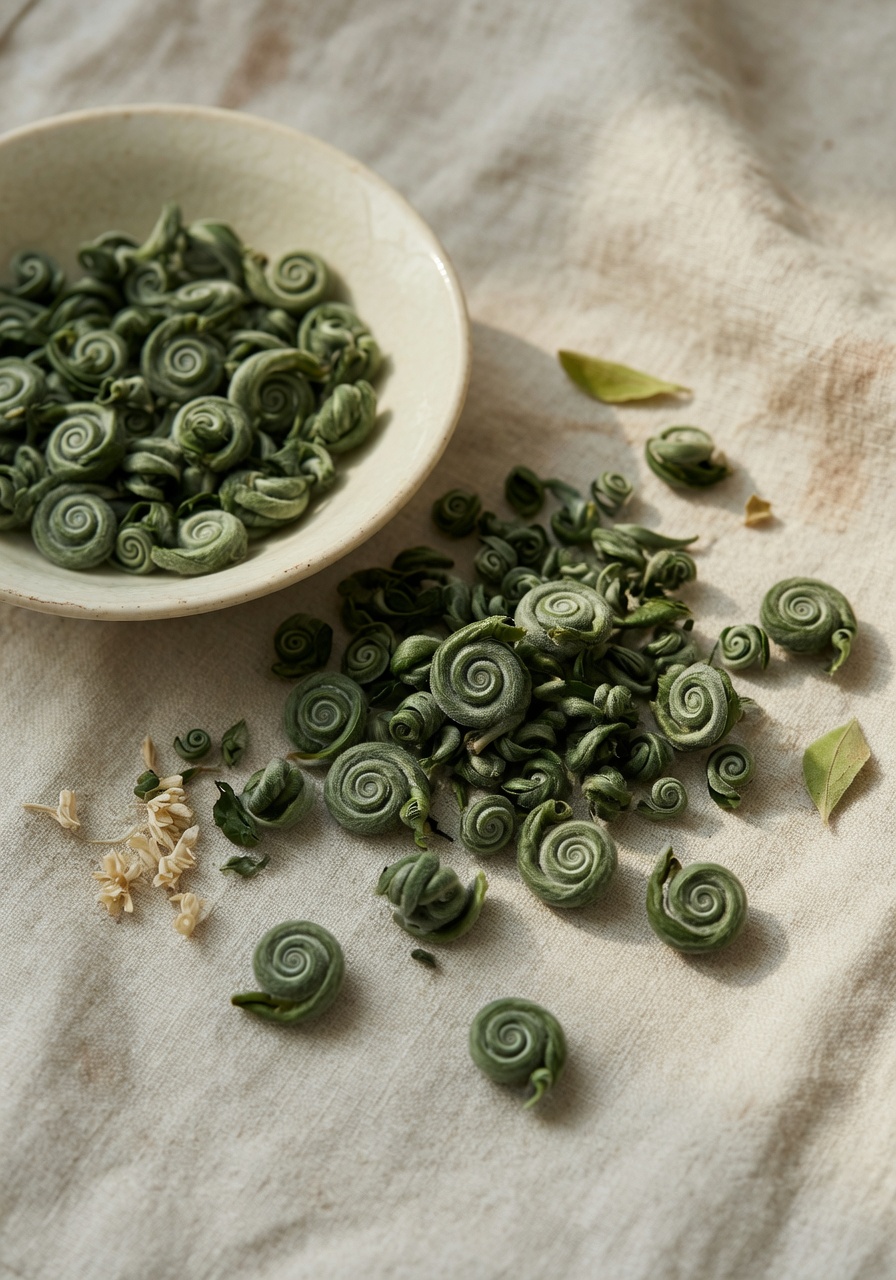
Tightly curled silver-green spirals, generous white down, fresh-cut grass and a faint almond-skin note.

wet leaf

Unfurls to slender bud-and-leaf sets, jade-bright, smelling of warm peapod and orchard blossom.

liquor

Pale chartreuse, slight haze from leaf fuzz, light catches white pekoe drifting in the cup.

aroma

Loquat blossom, raw chestnut, a green-bean-pod sweetness sitting just behind the florals.

taste

Soft mouthfeel, low astringency, sweet chestnut and white peach skin with a quiet mineral hum from the lake-island soils.

finish

Short, clean, returning sweetness across the tongue — a gentle *huígān* of cane sugar and cucumber.

Brewing

A method, not a recipe.

Method
western
Ratio
3g / 200ml
Water temp
75–78°C
First infusion
60s
Subsequent
2–3 infusions; add 30–45s each time

Pour water first, then drop leaves on top — biluochun sinks slowly and bruises easily. Glass tumbler preferred to watch the dance.

Sourced by

Chen Hui Yi

Senior Tea Expert (White, Green & Yellow Tea Varieties)

Full profile →